Prophecy and the
Ghost of Tom Joad
Wherever there's somebody fightin'
for a place to stand
Or decent job or a helpin' hand
Wherever
somebody's strugglin' to be free
Look in their eyes Mom you'll
see me."
Bruce Springsteen
This year marks the 75
th anniversary of that great work
of American literature The Grapes of
Wrath by John Steinbeck. It
told the story of Tom Joad and his family who were forced off the
family farm in Oklahoma by drought and depression and who made their
way to California where they met further hardship brought on my
desperate working conditions and low wages. It was recognized then
as a wake-up call to the American people of inequality and
persecution of our economic system. This book can be considered both
historical and prophetic. Historical in its description of the
desperation of the dust bowl farmer’s family and prophetic in its
warnings that it could happen again. Could it be that the prophecy of
this book is being realized right now in our country?
Although the cause can be debated there is little disagreement
that climate change is occurring. In areas that used to be
non-arable there are now verdant fields of green crops that feed not
only our nation but many others. It is only because of irrigation
that this is possible. But consider this. The Colorado River no
longer flows to the Gulf of California but now fizzles out before it
gets there. For millenia it flowed but now it is diverted before it
reaches its historical destination. Nebraska, Colorado and parts of
Kansas along with the Central Valley in California are in the depths
of an extended drought. Those states on the Western Plains have for
decades drawn water from the Ogallala aquifer and it is being
depleted at a rapid rate. It is projected to be 70% depleted by 2060.
Replenishment will take hundreds if not thousands of years. In
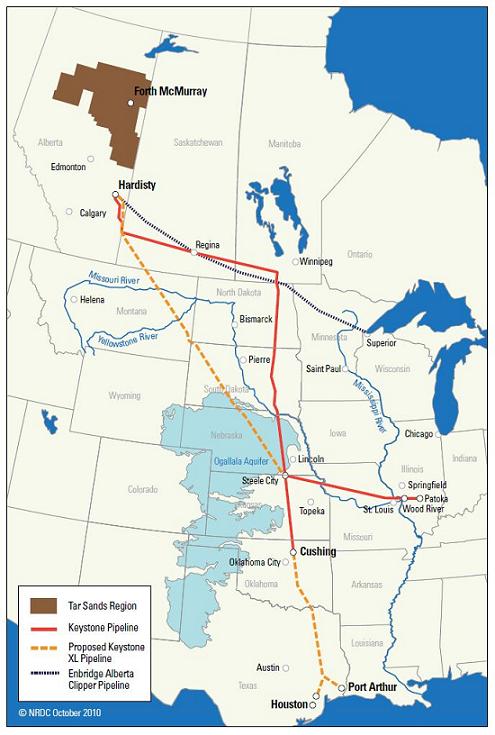
addition, the proposed Keystone XL pipeline is set to go right over
this precious water resource. We are not the only country
experiencing climate change. Australia is in a period of extended
drought as are other parts of the world.
Effects of the drought in California
In the 1930s the western states were referred to as “the dust
bowl.” Long years of improper farming techniques had depleted the
land and left it barren, a ready victim for the drought and winds
that came and blew what topsoil was left to parts unknown. In our
case it is not so much the farming techniques as it is an
over-reliance on irrigation from sources that are adversely affected
by climate change. One must remember that the Anasazi and the Navajo
were forced off the land by drought.
In Steinbeck's time there weren't so many corporate farms. Most
were family farms and the desperation and want was threatening mostly
to those small farmers but now large corporate farms tend thousands
of acres and failure of those farms will adversely affect people
globally. What many don't realize is that wars have been fought over
less. What would a nation on the brink of collapse due to starvation
be capable of?
Just think of it. The corn that feeds our beef comes off the
great plains as does the wheat for our bread. The fresh vegetables
and fruit come from the groves of California. If shortages occur the
prices for food will skyrocket (and we are seeing that happen now)
leaving many without access to enough food. It won't be the rich
that experience the need and want. They will have enough money to
weather the storm but the rest of us won't. Those of us who make it
from paycheck to paycheck will face some hard choices. Those who
aren't making it now will face starvation. When that happens what do
you suppose will happen to our government with increasing demands
from the people? We can take a lesson from John Steinbeck's time.
The Joads left their dusty farm for work in the orange groves. But
what happens when the oranges won't grow? In that time the people
demanded more and it was a time of great social change and government
intervention.
I have always grown a garden but it is a far cry from being a
subsistence garden. We still spend a fortune at the grocery but the
garden does provide us with good food in season and we can and freeze
quite a bit. We have the land that we can use for that but that is a
rarity these days. I dare say that butchering a hog or a beef is
something most of us have never done. We have lost those skills our
grandparents had. But by far the most damage is being done by the
marginalization of the middle class. The middle class now lacks the
discretionary money to save for a rainy day. Instead of using
federal resources to build up and support the middle class the money
goes to the wealthy in the form of tax expenditures. Now the largest
corporations may pay no taxes at all instead garnering refunds from
the federal government due to the tax expenditures built into the tax
code.
But it is not all darkness and gloom. There are things we can do
if we choose to make the difficult decisions to do so. We can reform
our tax code so that the federal government has enough funding to
repair roads and bridges. We can institute conservancy efforts to
minimize the amount of valuable natural resources we consume. We can
move toward energy sources that do not contribute to the effects of
climate change. Scientists now say that we will not avoid the
effects of climate change but we still can keep it from becoming
exceedingly severe. We can begin to make long term investments in
human capital that will strengthen the great base of our country.
The one thing we should not do is wait until disaster forces drastic
action. We can't afford the luxury of thinking there is a painless
way to our future. We can't do it individually and we can't get
there believing that government is incapable of serving our needs.
Tom Joad faced a terrible disaster in the dust bowl and the Great
Depression but what is ahead has the potential to make that look like
a walk in the park.
My take is that this time when the wolf comes to the door the
people will want more than straw to build their houses.


 Posting after the UK-UConn game. I didn't post following the Wisconsin game simply because the chance of hanging a ninth banner loomed large. When BBN gets that close there is a singular focus. The Cats pulled it out with that now famous Aaron Harrison jump shot and that put us over the moon. But then it almost instantly became a waiting for the next game.
 The draft projections I have seen through the first 30 have Randle, Willie and Young being selected. Harrisons could be taken lower if they decide to go. They could benefit from another year but there is another point guard coming. Poythress will stay and he promises the chance of becoming the beast Cal says he can be. Johnson, Lee, Hawkins all promise to be great players.
 .Diane Feinstein gets some help in battle against CIA.
  The news of this report was published in the local paper but it seemed that it was only to put the hospital administration's defense forward. The hospital said that the problem was not in the safety record but, rather, in the data that the hospital had provided to Medicare and Medicaid and that when those errors were corrected the local hospital had a safety record comparable to others of this size. There was no attempt to verify those claims nor was there any mention of the reporters queries about the veracity of the CEO's statements. In other words, a whitewash.
